

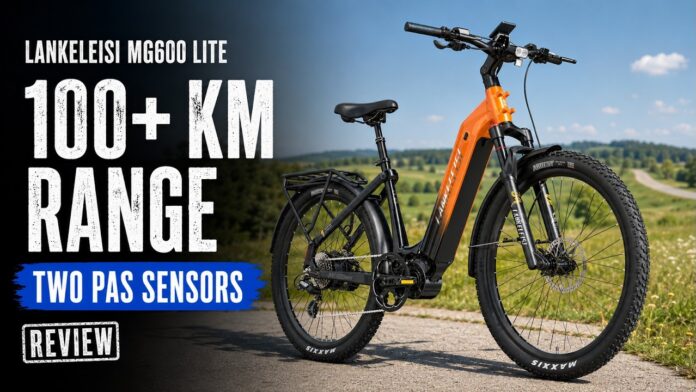
The Lankeleisi MG600 Lite looks like a conventional, well-equipped trekking bike. It does not have four-inch fat tires, an aggressive frame or two oversized motors. Instead, it offers a low-step frame, an integrated battery and standard 27.5-inch wheels, making it suitable for commuting, recreational riding and longer weekend trips.
After spending more time with it, I discovered that the MG600 Lite is more interesting than its restrained appearance suggests. It allows the rider to switch between a torque sensor and a cadence sensor directly from the display. During my range test, the 720 Wh battery lasted for nearly 90 km, while the rear hub motor proved to be one of the quietest I have experienced on an e-bike.
Unfortunately, the bike is not free from problems. The first issue appeared during assembly, the battery later became stuck inside the frame, and the optional throttle module caused the bike to accelerate without a rider.
So, is the Lankeleisi MG600 Lite a refined electric trekking bike, or is it a collection of good ideas undermined by inconsistent quality control? This review covers its real range, motor performance, sensor modes, comfort, equipment, limitations and the safety issue I encountered during testing.
The bike was supplied for review by BuyBestGear, a partner of my channel. Neither the store nor the manufacturer had any influence over the advantages, disadvantages or final verdict presented in this article. The purchase link is an affiliate link, which means I may receive a small commission without increasing the price paid by the buyer.
You can watch my complete video review below, including riding footage and the problems described in this article:
Lankeleisi MG600 Lite specifications
The Lankeleisi MG600 Lite is a low-step electric trekking bike with a 250 W rated rear hub motor, a 720 Wh battery and two switchable pedal-assist sensors.
| Specification | Lankeleisi MG600 Lite |
|---|---|
| Motor | Rear brushless hub motor |
| Rated power | 250 W |
| Peak power | Approximately 650 W |
| Maximum torque | Up to approximately 65 Nm |
| Battery | 36 V, 20 Ah, 720 Wh |
| Battery cells | Samsung cells, exact model not specified |
| Charger | 3 A |
| Charging time | Approximately 6-8 hours |
| Pedal sensor | Switchable torque or cadence sensor |
| Assist levels | Five |
| Wheels and tires | 27.5 x 2.4-inch Maxxis Ardent |
| Drivetrain | Shimano Altus 1 x 8 |
| Brakes | ZOOM HB876 four-piston hydraulic brakes |
| Front suspension | 120 mm travel |
| Rear comfort system | Suspension seatpost on the 2026 version |
| Bike weight | Approximately 30 kg |
| Claimed maximum load | 200 kg |
| Factory assist limit | 25 km/h |
| Manufacturer’s claimed range | Up to 120-150 km |
The declared maximum range should be treated as an ideal-condition estimate. My real-world result was lower, but still very good for a trekking e-bike in this price range.
A design that does not shout about being electric
The MG600 Lite looks more like a traditional trekking bike than an electric moped. Its battery is integrated into the down tube, the cables are routed neatly and the cockpit does not look like a random collection of wires and connectors.
I tested the gold and black version. In strong sunlight, the upper section of the frame has a metallic sparkle that makes the bike appear more expensive. The effect becomes less pronounced in weaker light, but the overall finish still looks clean and attractive.
The low V-shaped frame is one of its most practical features. You do not need to lift your leg high over the saddle, which is useful for shorter riders, people with limited mobility and anyone carrying a bag on the rear rack.
I only wish the manufacturer had covered the unused mounting holes at the front of the frame. Two matching bolts or a small branded cap would have made the finish look more complete.
Assembly requires a careful inspection
Assembly was more involved than with most electric bikes I have tested. In addition to fitting the usual components, I had to attach the crank arm to the bottom bracket. This is normally completed at the factory.
The installation itself was not difficult. The problem appeared later when the retaining bolt began to loosen. I could feel slight movement and a crunching sensation through the pedal.
Applying thread locker and tightening the bolt correctly should solve the problem, but a customer should not have to discover this while riding. The manufacturer could have installed the crank arm at the factory or included an appropriate thread-locking compound.
The rear derailleur also needed a minor adjustment because it rubbed slightly in the lower gears. These issues were manageable in a garage, but I strongly recommend checking every important fastener, the brakes, drivetrain and battery mounting before the first long ride.
If you are not comfortable assembling and adjusting a bicycle, having the bike inspected by a local workshop would be a sensible precaution.
How good is the MG600 Lite motor?
The rear hub motor is quiet, smooth and strong enough for commuting, touring, gravel roads and moderate climbs. Its greatest advantage is not outright power, but refinement.
The specification lists 250 W of rated power, approximately 650 W of peak output and up to 65 Nm of torque. Pedal assistance is limited to 25 km/h from the factory.
In my hilly area, the bike handled climbs well. On steeper sections I occasionally needed to select an easier gear and contribute more effort, but the motor remained stable and did not repeatedly surge or cut power.
The 36 V system does not have the same power reserve as some heavier 48 V e-bikes. If your priority is extreme acceleration, difficult off-road terrain and very steep climbs, you might prefer something closer to the dual-motor bike covered in my Duotts F26 review.
For normal city use and recreational touring, however, the MG600 Lite has enough power. More importantly, it is exceptionally quiet. Assistance starts quickly, stops promptly when you stop pedalling and does not produce the loud whining noise found in many rear hub motors.
After testing numerous e-bikes, I have learned to appreciate this kind of refinement. It does not stand out in a specification table, but it makes every ride calmer and more enjoyable.
Two pedal sensors in one e-bike
The ability to switch between a torque sensor and a cadence sensor is the most distinctive feature of the Lankeleisi MG600 Lite. It allows the same bike to provide two noticeably different riding experiences.
Torque sensor mode
In torque sensor mode, the motor responds to how hard you press on the pedals. Apply light pressure and the bike provides gentle assistance. Push harder and the motor contributes more power.
The result feels natural and predictable. You still feel as though you are riding a bicycle, while the motor simply amplifies the effort produced by your legs.
This was my preferred setting. The response is quick, power delivery is smooth and the differences between the five PAS levels are meaningful. I completed most of my test on levels two and three rather than constantly using maximum assistance.
The experience is similar to what I liked about the torque-sensing system in my ENGWE P275 SE review, although the MG600 Lite gives the rider the additional option of changing to cadence sensing.
Cadence sensor mode
When switched to cadence mode, the personality of the bike changes. Simply rotating the crank activates the motor, which then aims for the speed associated with the selected PAS level.
The bike does more of the work and begins to feel closer to a scooter. This may not appeal to riders looking for a natural cycling experience, but it can be useful when returning home tired or when trying to minimise physical effort.
This is closer to the assistance behaviour found on many affordable e-bikes, including some of the characteristics described in my Duotts C29 review.
The important difference is that you do not have to choose one sensor when ordering the MG600 Lite. Both are included, and you can adapt the bike to your route, energy level and preferred riding style.
Real-world battery range
I covered nearly 90 km on a single charge during my Lankeleisi MG600 Lite range test. I used the second and third assistance levels for most of the route, maintained an average speed of approximately 21 km/h and did not ride exclusively on flat terrain.
That is an excellent real-world result.
The bike uses a 36 V, 20 Ah battery with 720 Wh of stored energy. Samsung cells are listed in the specification, although their exact model is not identified. The included 3 A charger requires approximately 6-8 hours for a full charge.
The manufacturer claims up to 120-150 km of pedal-assisted range. Such a result may be possible with a light rider, low assistance, favourable weather, correct tire pressure and a relatively flat route. It should not be treated as a guaranteed everyday figure.
Based on my experience, approximately 80-90 km is a sensible expectation when using moderate assistance in mixed conditions. Higher PAS levels, low temperatures, strong wind, additional cargo and frequent climbing will reduce that figure.
The battery became stuck in my test bike
The battery itself is one of the strongest parts of the MG600 Lite. Its mounting system was not.
The battery is designed to be removed from the frame, allowing it to be charged indoors. In my review unit, however, it became firmly stuck and would not come out despite repeated attempts to unlock it correctly.
This was the first e-bike I had tested where removing the battery became such a serious problem. It may be particularly inconvenient for someone living in an apartment who cannot bring the complete 30 kg bike close to a power outlet.
After receiving the bike, I recommend immediately checking that the battery lock and removal mechanism operate correctly. Discovering this issue after the battery has run low is far less convenient.
Handling, tires and riding without assistance
The MG600 Lite feels stable and predictable on asphalt, gravel and easier forest paths. The Maxxis Ardent tires are one of the reasons why.
Their 27.5 x 2.4-inch size provides considerably more grip and cushioning than a narrow urban tire without creating the heavy, floating sensation of a four-inch fat tire.
Rolling resistance is surprisingly low. I first noticed this during assembly, when a lightly spun wheel continued rotating for a long time.
This also helps when riding without electrical assistance. At approximately 30 kg, the MG600 Lite will never feel like a lightweight trekking bike, but its conventional wheel size, efficient tires and Shimano Altus 1 x 8 drivetrain make it possible to continue riding if the battery runs out.
The manufacturer claims a maximum load of 200 kg. I did not independently test that limit, but it is significantly higher than the 120-150 kg figures commonly listed for many electric bikes.
The handlebar angle can be adjusted to create a more upright riding position. At 182 cm tall, I found the bike comfortable, but moving the handlebar too close caused my knee to touch it during very tight turns. Taller riders should check this relationship carefully before finalising the setup.
Is the suspension seatpost comfortable?
The 2026 version includes a suspension seatpost, but its behaviour is not as refined as the product description might suggest.
It moves noticeably over larger bumps, causing the saddle to travel up and down. At times, it felt as though I was sitting on a small trampoline.
It was less sensitive over the smaller vibrations where I wanted additional comfort during urban riding. Its behaviour became most noticeable on cycle paths interrupted by repeated driveway crossings, where the surface rises and falls in quick succession.
Spring preload can be increased to reduce the amount of movement, but this seatpost should be treated as a simple comfort accessory. It does not replace full rear suspension.
The front fork offers 120 mm of travel and is adequate for urban obstacles, gravel and moderate off-road use. The MG600 Lite is not a full-suspension mountain bike and should not be treated as one.
Brakes, lights and standard equipment
The MG600 Lite uses four-piston ZOOM HB876 hydraulic brakes. They stop the bike safely, but I expected more immediate braking force from this specification.
During harder braking, I had to apply clear pressure to both levers. Several other e-bikes I have tested provided a sharper initial bite and stronger response.
My test unit also had a brake lever arrangement opposite to the one I normally use. The right lever operated the front brake and the left operated the rear. Cable lengths make a simple swap difficult, so every rider should verify the arrangement and develop the correct reflex before riding quickly.
The rest of the equipment is comprehensive. The bike includes aluminium fenders, a rear rack with a claimed 25 kg load capacity, a kickstand, front lighting, a brake light, rear turn signals and a loud electronic horn.
The rear lighting is highly visible and looks impressive at night. I would have liked to see indicators at the front as well.
The turn signals do not cancel automatically. A symbol appears on the display, but there is no audible reminder, making it easy to leave an indicator flashing after completing a turn.
The rubberised control buttons also require more pressure than expected. The horn is extremely loud and effective at attracting attention, although its electronic sound is not particularly subtle.
The throttle incident
The optional throttle module caused the most serious problem I encountered during the review.
The small module slides into a mounting point below the display and does not require a separate external cable. Once installed, it allows the motor to propel the bike without pedalling.
While I was recording static footage, the module had not been seated correctly and fell away from the handlebar while the bike was still powered on. Despite no longer being in its normal position, the control system interpreted the situation as a full throttle input.
The bike suddenly accelerated without a rider.
It travelled across the property before falling over on an uneven section of ground. The handlebar and derailleur were scratched, but fortunately nobody was injured.
I contacted the manufacturer and provided footage of the incident. The manufacturer explained that the bike must always be powered off before installing or removing the throttle module or any other components. In this case, the module was handled while the system remained switched on.
That clarification is important, but it does not change my conclusion. A disconnected or incorrectly seated control module should not cause the motor to apply power. The safer response would be for the system to register an error and disable the drive.
After this experience, I do not recommend installing the optional throttle.
Is the Lankeleisi MG600 Lite road legal?
In its factory pedal-assist configuration, the MG600 Lite is listed with a 250 W continuous rated motor, a 25 km/h assistance limit and a motor that operates while the rider pedals. These are the basic parameters expected of a conventional European pedal-assisted e-bike.
Under EU rules, pedal-assisted cycles with a continuous rated motor output of no more than 250 W are excluded from L-category vehicle approval when motor power stops as the rider stops pedalling and is progressively cut before reaching 25 km/h. The relevant wording can be found in [Regulation (EU) No 168/2013](https://eur-lex.europa.eu/eli/reg/2013/168/).
The bike’s menu allows the assistance limit to be increased to approximately 40 km/h, while the optional throttle enables motor-powered riding without pedalling. Using either modification may change the vehicle’s legal classification and make it unsuitable for use as a normal bicycle on public roads or cycle paths.
In Great Britain, comparable EAPC rules also use a 250 W continuous rated power limit and a 15.5 mph assistance cut-off. Throttle-controlled operation may require separate approval, as explained in the official [UK electric bike guidance]
Regulations vary between countries, so riders outside the EU should check local requirements. Raising the speed limit or installing the throttle should be reserved for private land where that configuration is permitted.
Display and smaller shortcomings
The colour display shows basic riding information and provides access to important settings, including the choice of pedal sensor.
Not every function is intuitive. I had difficulty resetting the trip data, and at one point the recorded trip distance was approximately half a kilometre higher than the bike’s total odometer reading.
The battery indicator is also basic. It uses bars rather than a percentage and does not provide a voltage reading. With such a long potential range, a more accurate remaining-charge display would be useful.
Main advantages
- Switchable torque and cadence sensor modes
- Nearly 90 km of real-world range in my test
- Exceptionally quiet rear hub motor
- Stable and predictable handling
- Low-step frame
- Good Maxxis Ardent tires
- Low rolling resistance
- Complete trekking equipment
- Discreet, conventional bicycle design
Main disadvantages
- Unsafe behaviour from the optional throttle module
- Battery stuck inside the frame on my review unit
- Crank bolt began to loosen
- Brakes were weaker than expected
- Suspension seatpost can feel bouncy
- Approximately 30 kg of weight
- Stiff control buttons
- Basic battery indicator
- Rear-only indicators without automatic cancellation
Who should buy the MG600 Lite?
The Lankeleisi MG600 Lite is best suited to someone looking for a comfortable electric bike for commuting, recreational trips and longer touring routes.
It is particularly appealing if you value easy mounting, a low-step frame, long battery range and the appearance of a traditional trekking bike rather than a motorcycle-inspired fatbike.
The switchable sensors also make it useful for riders who are uncertain which type of assistance they prefer. Torque mode offers a natural cycling experience, while cadence mode reduces the amount of effort required.
I would not choose this model for extreme off-road riding, very steep mountain routes or a home where the bike must regularly be carried upstairs. Riders expecting perfect assembly directly from the box should also budget for a basic workshop inspection.
Is the Lankeleisi MG600 Lite worth buying?
The Lankeleisi MG600 Lite is worth considering if range, a quiet motor, easy mounting and flexible pedal assistance are your main priorities.
Nearly 90 km on one charge demonstrates that the 720 Wh battery performs well outside a specification sheet. The Maxxis tires, low rolling resistance and natural torque-sensor mode also make it genuinely enjoyable to ride.
It is not a bike I can recommend without reservations. The stuck battery, loosening crank bolt, average braking response and throttle incident demonstrate that the bike requires a careful inspection before regular use.
Despite those problems, I grew to like the MG600 Lite. It is comfortable, stable and capable of completing long routes without forcing the rider to constantly worry about the remaining battery level. I expect to keep using it, but the optional throttle will remain in the box.
Check the current price and buy now
You can also watch my other electric bike reviews on YouTube and compare the MG600 Lite with the other models I have tested.
FAQ
What is the real range of the Lankeleisi MG600 Lite?
I covered nearly 90 km on one charge while using mainly the second and third assistance levels. My average speed was approximately 21 km/h, and the route was not completely flat. Higher assistance, colder weather, more climbing or a heavier load will reduce the range.
Does the MG600 Lite have a torque sensor?
Yes. The bike includes both a torque sensor and a cadence sensor, and the rider can switch between them through the display. Torque mode responds to pedal pressure, while cadence mode activates assistance when it detects that the crank is rotating.
How long does the battery take to charge?
The supplied 3 A charger requires approximately 6-8 hours for a complete charge. Actual charging time depends on the battery’s remaining capacity and temperature.
Can the MG600 Lite be ridden without electrical assistance?
Yes. The bike weighs approximately 30 kg, but the conventional wheel size, Maxxis tires and Shimano Altus drivetrain make riding without assistance possible. Hills will require considerably more effort because of the bike’s weight.
Can the battery be removed for indoor charging?
The battery is designed to be removable. Unfortunately, it became stuck inside the frame of my review unit and could not be removed normally. I recommend testing the locking and removal mechanism immediately after receiving the bike.
Is the Lankeleisi MG600 Lite suitable for tall riders?
The manufacturer lists a recommended rider height of approximately 160-195 cm. At 182 cm, I found the bike comfortable, although moving the adjustable handlebar too close caused my knee to touch it during tight turns.
Is the Lankeleisi MG600 Lite good for hills?
The motor performs well on moderate climbs and rolling terrain. On steeper hills, the rider needs to select an easier gear and contribute more effort. It is not intended to replace a high-powered 48 V mountain e-bike.
Is the optional throttle safe to use?
I do not recommend installing it. During my test, handling the module while the bike remained powered on resulted in the bike accelerating without a rider. The manufacturer states that the bike must be switched off before installing or removing any components.

